OCPP 2.0.1 Released

We have been waiting a long time for this announcement from the Open Charge Alliance:

The full and official version of OCPP 2.0.1 is released and open to the public. OCPP 2.0.1 replaces OCPP 2.0 and features several bug fixes and improvements based on experiences in the field. As some of these improvements are on message level, the version number of OCPP has been increased to 2.0.1.

OCPP 2.0.1 incorporates improvements for things found in the first implementations of OCPP 2.0 during our Plugfests and in the field. Improvements have been made in the area of Security, ISO 15118, Smart Charging and the extensibility of OCPP. A better explanation of the Device Model has been added as well as several other improvements. No new functionality is added to this release.

However it appears as though the wait has been largely in vain from our particular perspective, since the announcement makes no mention of “smart discharging”,  more popularly referred to as V2G.

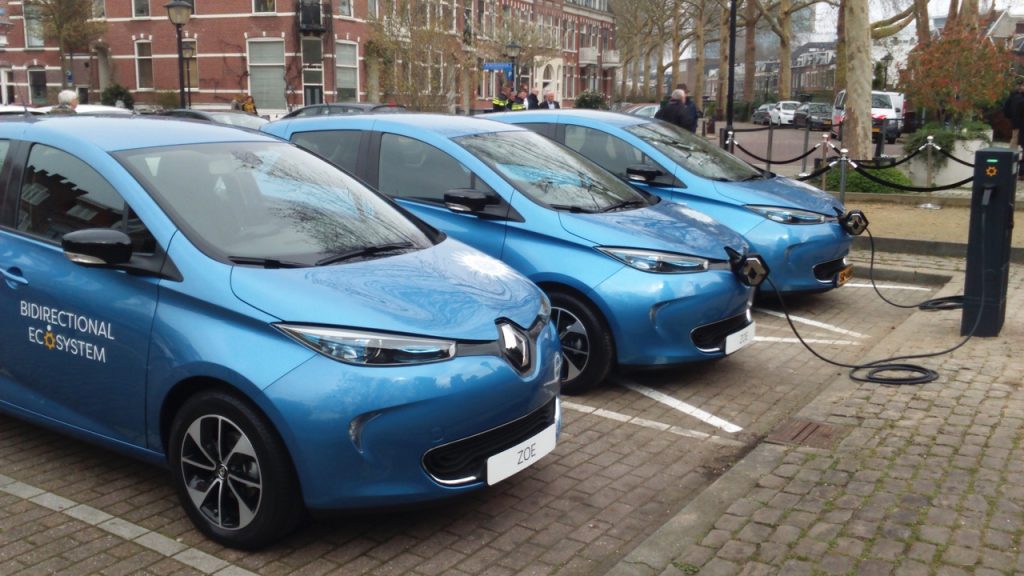
These Renault ZOE’s, pictured in Utrecht last year, do support vehicle-to-grid operation and the ISO 15118 protocol between the charging station and EV. However that is achieved by using non-standard extensions to OCPP 1.6:

The OCA have made another announcement recently as well. Here it is:

The Open Charge Alliance (OCA) has noticed that there is an increasing interest in the activities of the alliance and that companies are eager to take the next step with OCPP. Although we cannot meet face-to-face due to the worldwide COVID-19 virus, the OCA wants to share knowledge and help everyone with their implementations and innovative ideas. Therefore we are happy to announce that we will be organizing a short series of webinars about OCA’s activities parallel to the Online OCPP 2.0.1 Plugfest on April 20th and 21st.

These webinars are free and open to everyone. You don’t have to be a member of the Open Charge Alliance or have in depth knowledge about the topics.

I’ve already signed up for the “OCPP 2.0.1 tutorial” option. The other available topics are:

  • What is the Open Charge Alliance?
  • OCPP 1.6 certification program.
  • OCPP 1.6 Compliance Testing Tool.

You can get your own copy of the OCPP 2.0.1 specification via the download section of the OCA website.

UK Government Funded Home EV Chargepoints Must Be “Smart” By July 2019

The UK Government announced earlier today that:

All government funded home chargepoints for electric vehicles must use innovative ‘smart’ technology from July 2019, the government announced today, fulfilling the commitment in the Road to Zero Strategy published earlier this year.

This means chargepoints must be able to be remotely accessed, and capable of receiving, interpreting and reacting to a signal. Smart charging can also reduce high peaks of electricity demands, minimising the cost of electric vehicles to the electricity system – and keeping costs down for consumers by encouraging off-peak charging.

Alongside this the government has also announced that they have maintained grants to install chargepoints at home and in the workplace at their current level of up to £500, making charging easier for consumers and ensuring that plug-in hybrids and battery electric vehicles can be used to their full potential.

Any “domestic” electric vehicle charging station manufacturers who feel they may be unable to meet the UK Government deadline using their in house resources may wish to contact the team here at V2G EVSE to obtain more information about our UK Department for Transport funded “smart” international standards compliant EVSE controller, particularly if vehicle-to-grid functionality is also of potential interest.

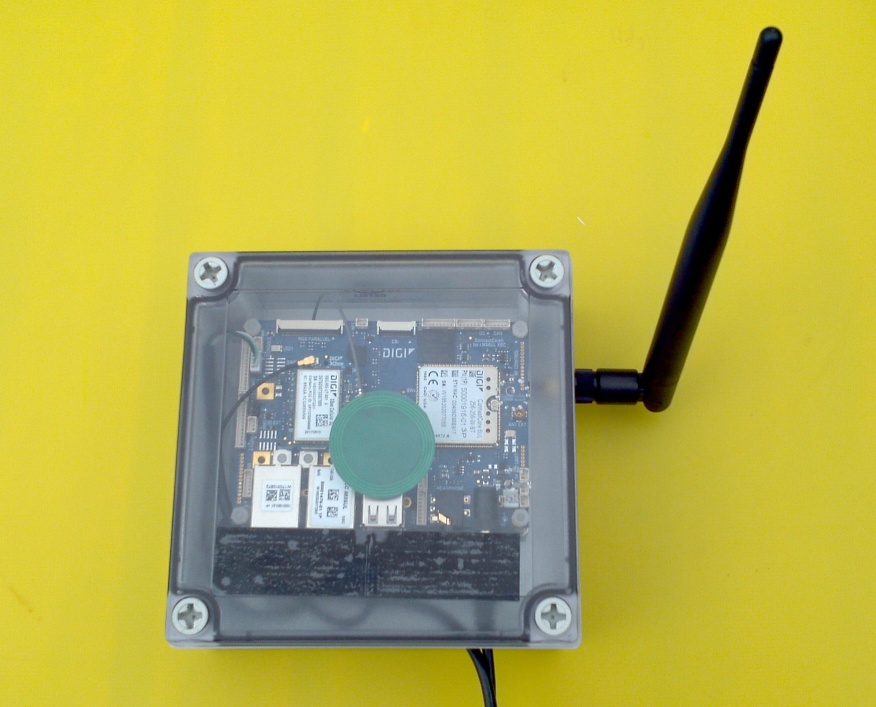
A picture is said to be worth a thousand words, so here’s what our proof of concept smart controller looks like:

V2G EVSE ISOSEC Project Attracts OLEV Funding

Tremail – 26 October 2018

For immediate release

  • V2G EVSE secures OLEV funding to assess the feasibility of combining their V2x ready smart EV charging station controller with the Urban Electric UEone pop-up charger
  • ISOSEC (Inconspicuous Smart On-Street EV Charging) is a £114,000 project with Urban Electric Ltd, Plymouth City Council, Energeo Ltd, Duku and Urban Foresight Ltd

V2G EVSE Limited’s “Inconspicuous Smart On-Street EV Charging” (ISOSEC) project is part of the “Electric vehicle charging for public spaces: feasibility” competition, funded by the Office for Low Emission Vehicles (OLEV) and administered by Innovate UK.

As a first phase of an innovation funding programme worth approximately £40 million, 27 feasibility studies will analyse the application and impact of innovative technologies for EV charging.

In particular, 18 feasibility studies will focus on how a well designed, well integrated EV charging infrastructure in public spaces can help facilitate the adoption of electric vehicles (EVs) among local residents without access to home charging due to a lack of off-street parking.

9 feasibility studies will instead focus on the application of Wireless EV charging to commercial users, reducing business disruptions when charging the vehicles and therefore increasing the attractiveness of the EV proposition.

These projects will assess the feasibility of defining sustainable models intended to maximise the effectiveness and impact of infrastructure deployment. The wide variety of technologies and business models analysed in these studies will help implement a charging infrastructure that is affordable, dependable, and fair for all road users, as well as making owning an EV an attractive proposition for all.

In a subsequent phase of the funding round, the best projects will be competing for funding for implementation of real-world demonstrators.

The ISOSEC project will investigate the feasibility of combining Urban Electric Limited‘s UEone pop-up (retractable) charging post with V2G EVSE’s standards-compliant V2x-ready smart charging station controller.

This system builds on the Urban Electric UEone charger being trialled with Oxford City Council, and develops it into a smart charging solution.

The project will also assess the feasibility of using big data and geographical information systems to locate EV charge posts where they can maximise their potential to deliver grid services to DNOs together with creating a Special Purpose Vehicle (SPV) funding model to:

  • Enable the roll-out of charging posts at no-or-low cost to local authorities
  • Generate revenue for the local authority over the lifetime of the SPV

The other collaborators on the ISOSEC project are:

Commenting on the award of the OLEV funding Olivier Freeling-Wilkinson, cofounder of Urban Electric, said that:

Urban Electric is focused on developing charging infrastructure that does not detract from the urban environment. We are excited to be collaborating with our consortium partners to explore the feasibility of developing the UEone pop-up charger as a smart charging solution.


V2G EVSE’s CEO Jim Hunt added:

It was a great pleasure to work with Keith and Oli on the preparation of our bid over a comparatively short period of time. We have a great team of collaborators, and I very much look forward to working with them all on assessing the feasibility of both our innovative on street charging business model and the potential for integrating our smart charging station controller into the UEone EV charging post.


Ian Dee, CEO of energeo remarked that:

Energeo are delighted to be part of project ISOSEC, which aims to address some of the key issues around EV infrastructure roll-out in complex urban environments. We’re particularly excited to assess the role geospatial big data and analytics can play in locating charging infrastructure to maximise utilisation and support the delivery of grid services.


Dan Turner, Low Carbon City Officer for Plymouth City Council, pointed out that:

Plymouth City Council are committed to further developing EV infrastructure in both public spaces and on street charging. We are excited to be collaborating with such innovative partners to assess the feasibility of installing pop-up chargers and we hope that this work can lead to the development of an on street charging business model in order to help Plymouth become a more sustainable place to live.


Paul Blakeman, Head of Innovation at Urban Foresight, commented:

Urban Foresight is a smart cities consultancy focused on helping cities to procure innovation, manage innovation pilots and deliver smart city programmes. We are excited to be collaborating with this group of consortium partners to assess how smart charging can be implemented to support EVs in Plymouth.

** END **

About V2G EVSE

V2G EVSE Limited is a British electric vehicle charging startup based in North Cornwall. In March 2018 the company began development of a Vehicle-to-Grid controller with modular communications using seed funding provided by a Department for Transport T-TRIG grant. Jim Hunt, V2G EVSE’s CEO, sits on a number of British and international smart-grid and electric vehicle standards setting committees. The V2G EVSE controller firmware will incorporate those emerging standards as they develop.

V2G-EVSE.com. Contact: email hidden; JavaScript is required


About Urban Electric

Urban Electric Networks Ltd is a British electric vehicle charging startup formed in London in June 2017 by Olivier Freeling-Wilkinson and Keith Johnston in the belief that EV charging infrastructure should impact positively on urban streetscapes. Voted Top 30 European Cleantech Start-up 2018 by Climate-KIC, the EU’s climate innovation agency.

urbanelectric.london. Contact: email hidden; JavaScript is required


About Energeo

Energeo utilise geospatial Big Data, Open Data, and Machine Learning to create unique insights into existing energy performance and future potential for renewable and sustainable energy. The company is currently using those techniques to pilot methods to identify the optimum location for electric vehicle charging infrastructure.

energeo.co.uk. Contact: email hidden; JavaScript is required


Plymouth City Council

plymouth.gov.uk. Contact: email hidden; JavaScript is required


About Duku (Albright Product Design)

Duku is a Product Design consultancy that provide help in taking an idea through to production including; prototyping, intellectual property and manufacturing support. Duku are currently working with Urban Electric on projects supported by Innovate UK to develop the UK’s EV charging infrastructure.

Duku.co.uk. Contact: email hidden; JavaScript is required


About Urban Foresight

Urban Foresight® was established in 2011 as the world’s first dedicated smart city consultancy. We are a mission driven business that thinks deeply about the opportunities to transform services and solve societal challenges.

Our multi-disciplinary team works across different sectors and is skilled at translating ideas into action.

We write award winning reports, provide evidence-based insights and deliver investment-ready strategies.

urbanforesight.org. Contact: email hidden; JavaScript is required

Department for Transport Invests in V2G EVSE

This morning the United Kingdom’s Department for Transport issued a press release which mentions us! It also mentions what is hopefully some very good news for other Great British small businesses too:

The Department for Transport (DfT) has today (6 August 2018) set out plans to level the playing field for small businesses bidding for government contracts.

In its SME Action Plan, the DfT has committed to directing a third of its procurement spending towards small and medium-sized enterprises by 2022.

As part of this pledge, the department has also awarded £700,000 in Transport Technology Research Innovation Grants (T-TRIG) to support innovative transport projects, including a universal train access ramp that would help disabled people board trains more easily across the network.

Transport minister Jo Johnson said:

Small and medium-sized businesses play a key role in this country’s economy and I am proud of our outstanding record in this area.

With this new action plan, we are leading by example by making it easier for these businesses to bid for contracts, and we will continue to support them over the coming years.

This year, out of 23 innovative transport projects given a share of £700,000, 14 were from small and medium-sized enterprises with fewer than 250 members of staff.

According to the Department for Transport’s aforementioned SME Action Plan:

This action plan outlines how the Department for Transport (DfT) will meet the Government’s aspiration of ensuring that 33% of all procurement spend will be with small and medium enterprises (SMEs) by the end of this Parliament, either directly or indirectly through the supply chain.

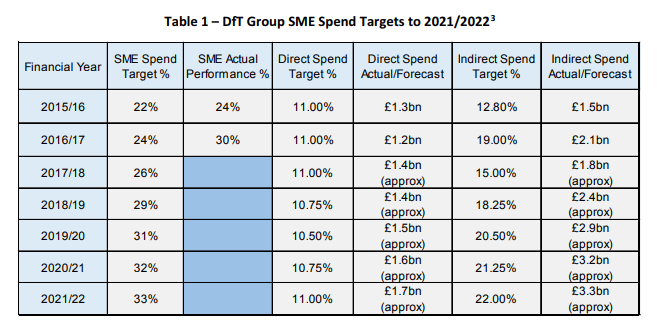
and here’s how the implementation of that plan is progressing:

2018-08-06_DfT_SME_Targets

Here at V2G EVSE we currently have far fewer than “250 members of staff”, and this is what the DfT had to say about our “Vehicle to grid controller with modular communications” project, seed funded by the Department for Transport in response to our “Transport Technology Research Innovation Grant Open Call” bid:

Developing a prototype for a vehicle to grid electric vehicle charging station controller, which will enable optimal charging across multiple vehicles, managing energy demand. This will include modular communications which will provide information to a central system.

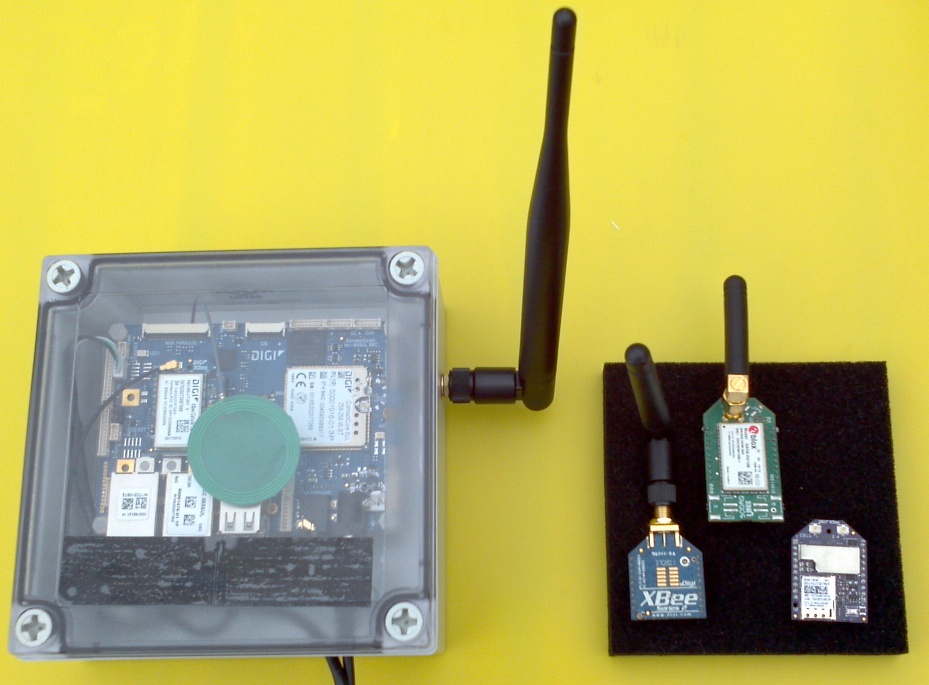
We were notified about our successful bid back in March, and a lot of progress has been made since then down here in North Cornwall! Here’s how the hardware side of our proof of concept EV charging station controller looks at the moment:

V2G-EVSE-Controller

With its assorted comms modules and their associated aerials it can currently communicate using Bluetooth “Low Energy”, WiFi, ZigBee, 2.5G, 3G, 4G, NB-IoT, LTE-M , “long range” WiFi, LoRa and Sigfox. Note first of all that not all of those technologies are suitable for the V2G use case. Note also that the V2x acronym covers a wide variety of ways of “improving the charging of electric vehicles” apart from just full blown vehicle-to-grid, including V1G (AKA “smart charging“), V2B (vehicle-to-building), V2H (vehicle-to-home) and V2I (vehicle-to-infrastructure).

From our perspective down here in sunny South West England the word “infrastructure” in the context of “electric vehicles” covers a range of Government departments. Electric vehicle charging stations definitely have one foot in the “transport” arena. In this day and age another one stands in the “energy systems” stadium as well. What’s more EV charging stations are not bipedal. Another foot is in the “digital” domain, and the fourth falls firmly in the “Future Cities” field.